Advocacy by Design / Lesson 9 of 17 · Light It Up
Paper Circuits
A coin cell and an LED made light. Now we give the electricity somewhere to go: copper tape — sticky on one side, conductive everywhere — turns any sheet of paper into a circuit board you can fold, draw on, and eventually wear.
The three circuits
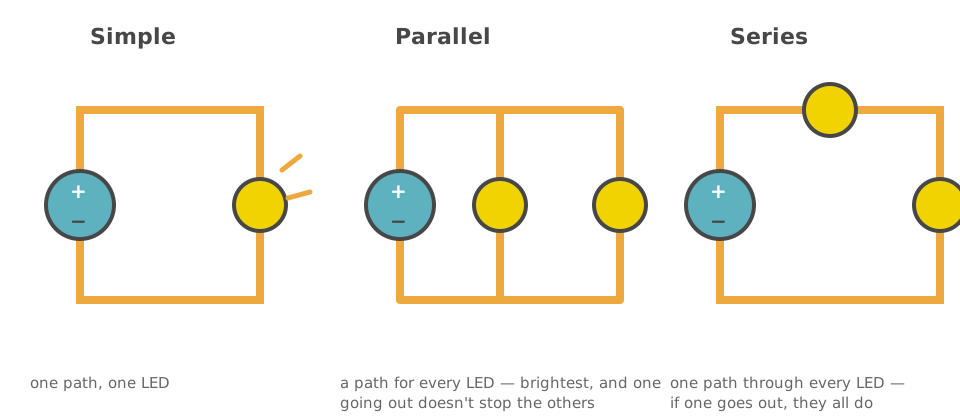
- Simple — one path, one LED. Your proof of life.
- Parallel — every LED gets its own path. Brightest, and if one LED dies the rest keep going. This is what runway pieces use — you do not want one loose leg blacking out your whole finale.
- Series — one path through every LED. Educational, dim, and fragile: one failure kills the chain. Build it once to understand why we don’t build it again.
Build all three
Print the Paper Circuit Practice sheet and lay copper tape along the paths.
The craft that makes it work:
- Peel a little backing at a time. Pull the whole strip and it tangles instantly — everyone does this exactly once.
- Corners: if your tape has conductive adhesive, tear and overlap freely. If not, make corners from one continuous piece — pull the tape the wrong way, then fold it back over itself in the right direction, so copper touches copper.
- LEDs do the splits: bend the legs flat apart, long leg taped to the positive path, short leg to the negative, clear tape holding each leg firmly down.
- The battery bridges the gap — positive path to its + face, negative path to its − face, and never both paths touching one face (that’s a short circuit: all current, no light).
When it doesn’t light (it won’t, at first)
Ninety percent of dead paper circuits are a leg not pressing hard enough on the tape — push it down. The rest: a hairline break in the tape, a sneaky short where + touches −, or non-conductive adhesive hiding between copper and leg (fold so copper touches copper).
Debugging is not the boring part before the project. Debugging is the skill.
For teachers: Order copper tape with conductive adhesive if you can — it removes the trickiest craft step. Have teams answer the worksheet’s removal experiment (pull one LED out of the parallel circuit, then the series one) out loud; it’s the moment the difference stops being a diagram.
Before you move on
- All three circuit types lit
- You fixed at least one dead circuit and can say what was wrong