Advocacy by Design / Lesson 4 of 17 · Research It
True Enough to Wear
A runway piece is a published statement. When your jacket says “109 people a day,” someone in the audience is going to ask where that number came from — and “I saw it online somewhere” melts under gallery lighting.
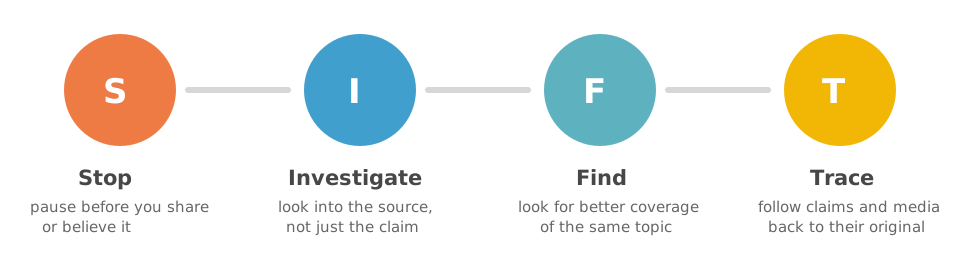
Before anything goes on your piece, it goes through SIFT, media researcher Mike Caulfield’s four moves for separating fact from fiction online:
Three words you need
- Misinformation — wrong by accident: mislabeled photos, garbled statistics, satire taken seriously.
- Disinformation — wrong on purpose: fabricated content, manufactured rumors.
- Malinformation — true information deployed to harm.
Your advocacy piece can accidentally spread any of the three. SIFT is the filter.
A real example, start to finish
Say you’ve heard that the fashion industry is the second-largest polluter in the world, and you want your Trashion piece to say so.
Stop. Where did you hear it? Everywhere, right? That’s suspicious by itself — huge round claims that “everyone knows” are exactly the ones to check.
Investigate & Find. A search for “fashion industry pollution rank” turns up a New York Times piece reporting that the “second-largest” claim is disputed — nobody can trace it to a real study. Other coverage (The Guardian, EcoCult) agrees fashion is a major polluter, but ranks it differently.
Trace. The original source of “second largest”? It doesn’t seem to exist.
The design decision: your piece drops the fake ranking and says what survives checking — fashion is a major polluter, and buying used beats buying fast fashion. Your argument just got stronger, because now nobody can dismiss it with “actually, that number’s made up.”
Activity: Check your claims
Each team lists the 2–3 factual claims their cause depends on, then runs each through a SIFT Fact Check sheet. Keep the sheets — they go in your exhibition display later as proof of process.
For teachers: For a deeper dive, Caulfield’s free Check, Please! starter course is excellent, and we keep student-adapted lessons and teacher notes for it. Short on time? The ten-minute version: each team answers “What do we know? How do we know it? Where will we verify it?” — then verifies it.